
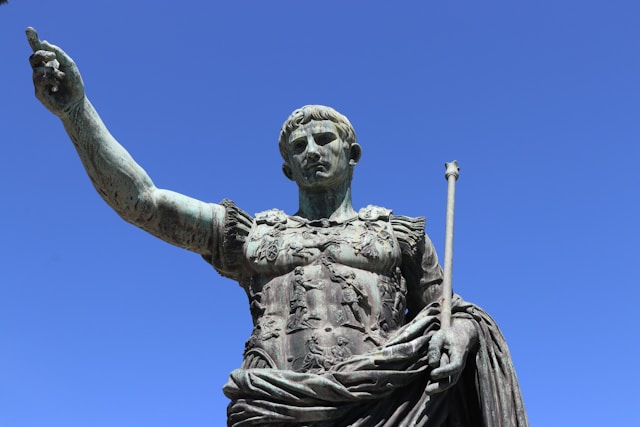
Photo by Clemens van Lay on Unsplash
Here’s the text of a sermon I preached at The Good Shepherd, Lee on 5th July 2026. You can listen at the church website.
The Bible readings were Romans 7.15-25; Matthew 11.16-19, 25-end
In the words of a famous film quote: What have the Romans ever done for us?
Which, after some discussion, becomes: All right, but apart from the sanitation, the medicine, education, wine, public order, irrigation, roads, a fresh water system, and public health, what have the Romans ever done for us? – Brought peace.
Our first reading today was from the book of Romans – not something that the Roman Empire gave us, but a letter, of sorts, written to a group or groups of new followers of Jesus in Rome, under the Roman Empire. These people were a mixture of people who were Jewish and people who were not. They lived and worshipped in the busy metropolis that was the city of Rome, and of course they were only a small minority of the total population. I say ‘of course’ because Christianity had not been going long at this point, and this was way before a Roman Emperor made it the official religion of the Empire.
The letter is from the Apostle Paul, St. Paul, who had never visited Rome, but he really wanted to, and so one of the roles the letter has is to introduce him to the church(es) in Rome. Significantly, it was carried to Rome by a woman called Phoebe, who probably not only was the letter carrier, but also the one who was trusted by Paul to explain what he was saying to the hearers of the letter when they, like us, got confused by Paul’s somewhat dense arguments.
So, there it is in the middle of our New Testament – the longest of Paul’s letters and perhaps the most forbidding. And perhaps the question arises: What has the book of Romans ever done for us?
It’s been described as the most significant letter ever written, and it has been the subject of study and debate and theologising ever since it was written. It’s got texts and quotes that can be taken to support all sorts of weird and wonderful theological, moral, ethical, and political positions. But as someone has said: A text without a context is just a pretext.
Today, the Lectionary has given us a text – a section of Romans chapter 7 – which one commentary I was looking at says is possibly the most difficult passage to interpret in the whole book! So, to avoid it becoming a pretext we need to put it in a bit of context.
Of course, its whole context is within the whole book of Romans, and perhaps within the whole of what Paul wrote, and you’ll be pleased to know that I’m not covering all of that this morning. But we’ll have a little look, to try to hear what God is saying to us now through these words. Have a Bible open to see the end of chapter 7 and the other sections around it, which I hope will help you to follow what we’re saying.
So, in this passage we read (verses 15-25) Paul says: I do this, I don’t do that, I want to do this, but I do that, I don’t understand, I, I, I… And so it might seem strange that the consensus among those who’ve studied this much more than I have is that Paul is not actually speaking about himself here! There are lots of reasons behind this which needn’t worry us this morning, but for one thing, elsewhere in Paul’s writing, he does not seem to experience this kind of angst – before he was following Jesus he was quite confident in his position as a Pharisee, and as a follower of Jesus he is even more confident in his life with Jesus.
And so it seems that Paul is using a well-known (at the time) way of making an argument called speech in character – using ‘I’ to express another person’s experience as part of your own argument. But who? Here there is less agreement, but clearly it’s someone struggling with living well; struggling with living how they want to live, and getting quite frustrated: ‘what a wretched man I am!’
In character, Paul refers to trying to follow the law. In the context of the earlier chapters, this is the law given to Moses – the Torah that shapes the lives of Jewish people – and Paul is not saying that the law is bad, but rather it shows up the ‘human propensity to mess things up’ which is a slightly toned down version of Francis Spufford’s helpful definition of ‘sin’.
And where is Paul going with this? The law, and our personal efforts and determination, are not enough. They only lead to frustration and feeling wretched. Paul’s answer, like all the best Sunday School answers is: Jesus! v.25 – Thanks be to God, who delivers me through Jesus Christ our Lord!
And he develops this into the start of ch.8 – one of the best-known and best-loved parts of Romans. It’s in the Lectionary for next week, but briefly here: Therefore, there is now no condemnation for those who are in Christ Jesus, because through Christ Jesus the law of the Spirit who gives life has set you free from the law of sin and death. For what the law was powerless to do because it was weakened by the flesh, God did by sending his own Son in the likeness of sinful flesh to be a sin offering. And so he condemned sin in the flesh, in order that the righteous requirement of the law might be fully met in us, who do not live according to the flesh but according to the Spirit.
Which brings us back to the gospel reading we heard, and to Jesus, and to Jesus’ invitation at the end of Matthew 11. At the risk sounding like an English comprehension question, look at the verbs Jesus uses in his invitation:
- Come to me
- Take my yoke upon you
- Learn from me
- …and you will find rest for your souls
Come to me, Jesus says. Come with your weariness and your burdens. In terms of Romans 7, come with your weariness of trying to live right in your own strength – I know that you don’t do what you want to do, and that you do what you try to avoid doing. That’s hard, and exhausting – just come.
Come to me, Jesus says. Don’t point fingers like the haters in v.19 – John was a grumpy loner and you didn’t like him; I’m happy to go to a party and you don’t like me! Stop judging and come!
Come to me, Jesus says…
Take my yoke, Jesus says. So much of what Jesus says in Matthew is turning things upside down – the upside down Kingdom. A yoke would have represented beasts of burden, or slavery – something put on an enslaved person or an ox, and it would have been hard work to lift or pull. And it came to represent the weight of all the Jewish laws and interpretations of the Jewish laws that the priests and law-experts came to put on the Jewish population – it was like a heavy yoke trying to follow all the details. Jesus flips this in two ways:
First, he doesn’t say, I will put this yoke on you, but ‘take my yoke upon you’. It’s Jesus’ invitation and it’s for us to respond. We get to take the yoke and put it on – it’s not forced upon us.
Second, Jesus says, ‘my yoke is easy’. In Greek, the yoke of Christos is chrestos. And chrestos doesn’t mean easy as in really simple and no trouble (although it might be). Jesus’ manifesto for the way to live is in the Sermon on the Mount – chapters 5-7 – and there are parts there that you might not say are ‘easy’.
But Jesus’ yoke is easy as in there’s an ease about it. Chrestos means suitable, worthy, good, pleasant, beneficial, helpful. There’s a rightness about what Jesus invites us to do, the way Jesus invites us to live – it might not always be ‘easy’ as we use the word, but it is right – it is fulfilling to live the way God designed us to live.
Come to me, Jeus says.
Take my yoke, Jesus says.
And learn from me, Jesus says, for I am gentle and humble in heart. Yes, there may – there will – be things that Jesus still has to teach us. Hence the invitation to learn – to be open to things we’ve not seen before, or change in unexpected ways – but Jesus is gentle and humble. …which is why it’s sometimes easy to miss, but we come and learn.
How does allegiance to Jesus look for you?
- Gail on fair trade
- Barbecue to grow our community
- Visiting someone in hospital
- Standing with someone who is being abused
- Choosing to spend time learning from Jesus – read, listen, talk
Don’t fall back into Romans 7 trying to do it all by yourself, but don’t think it doesn’t matter either – the freedom of Romans 8 is the freedom to live well.
How do we come? One way is when we get up out of our seats and come forward to take communion – the invitation that Chris will give is to come, and we can respond. But how, for you, could you come to Jesus and take that ‘easy’ yoke in your everyday life? Maybe it’s choosing to hear the words of Jesus instead of the words that so often fill the ether and fill our ears. Maybe there’s something else that comes to mind for you.
Come to me, Jesus says
Take my easy, good, beneficial, right, just, light yoke, Jesus says
Learn from me, Jesus says.
Are you listening?